Let's be honest about the state of sales technology. It's great at logging what you did. None of it helps you actually know the person you're talking to.
Each one was built to do something — and none of it was to help you understand the customer.
You need that Q3 case study — the manufacturing one. It's in there somewhere: "Marketing Assets," "Sales Collateral," or the folder called "FINAL USE THESE." Fifteen minutes of clicking nested folders and wrong-version PDFs later, you give up and wing it on the call. It was built to store things, not to help you sell.
Chase down success for a quote. Schedule the interview. Draft it. Legal approves. The customer approves. Design it. Publish it. Meanwhile your reps hear wins and outcomes on calls every single day — and that proof evaporates. The gap between stories you've formally produced and proof you actually have is enormous, and entirely self-inflicted.
It's not a tool that helps you understand your customer. It's something your company requires you to update so management can run reports. How many hours this week did you spend entering data that made you better at your customer's situation? It gave executives dashboards. It never gave anyone context.
Demo automation. RFP management. Competitive cards. They're fine at what they do. But they don't know what's happening with your customer, which story matches this buyer's concerns, or what was actually said on the last call. They solve a slice — and leave the understanding to you.
What this company is actually dealing with — not what their website says. Which customers faced the same thing. Which questions open up the real conversation.
Every time someone hears a real outcome, it becomes searchable. No six-week production cycle. No staleness. The story is always current.
An RFP answer that doesn't start with "let me search the library" — it starts from the customer's actual situation and shows you get it.
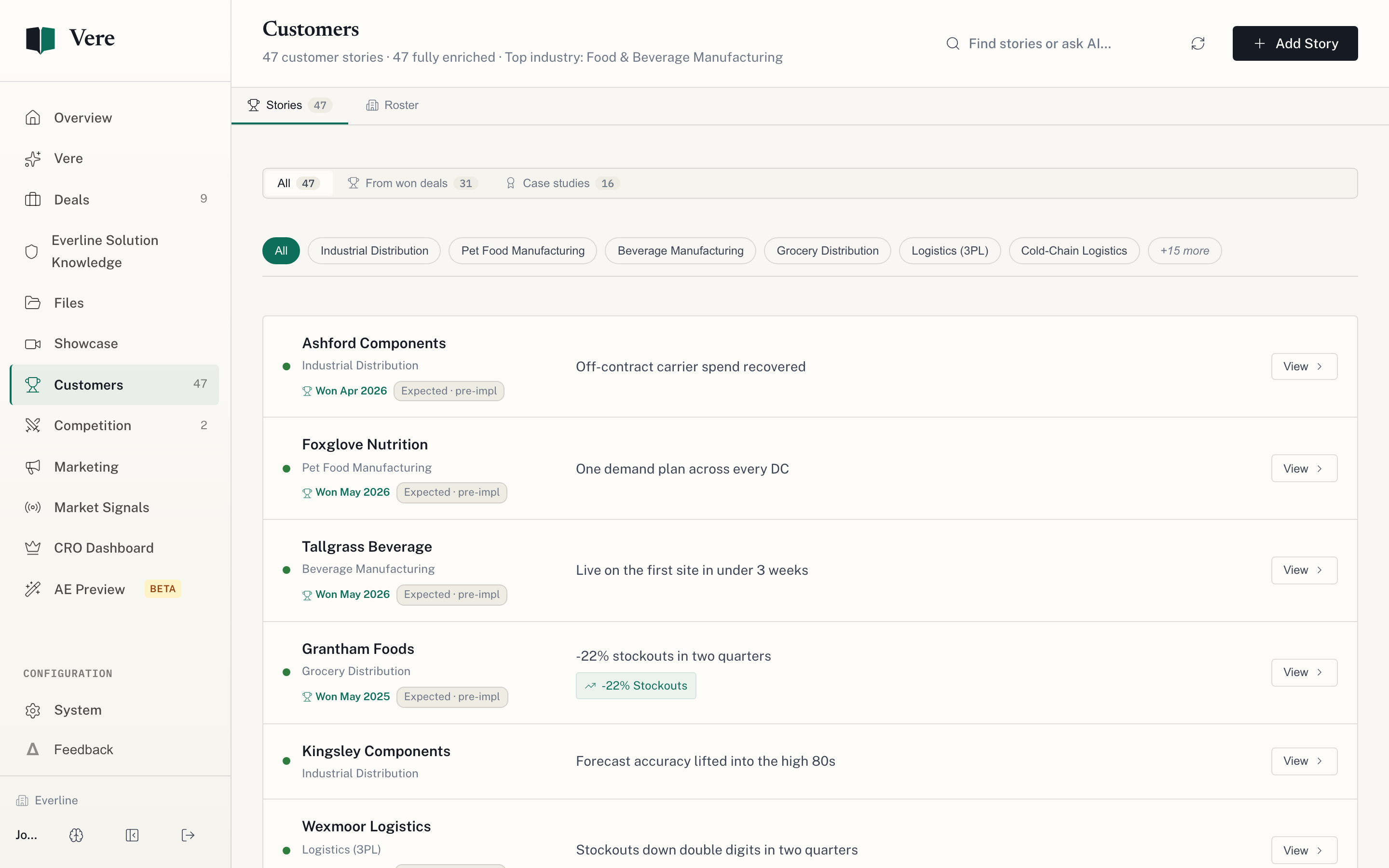
We didn't build Vere to be a better version of what exists.
We built it because what exists doesn't help you understand your customer.
Every conversation makes it smarter. Every outcome makes it more useful. Every piece of context, every customer story, every real-world experience feeds a system that gets better at helping you show up prepared. You've been making do with tools that track activity instead of building understanding. That's over.
Try Vere free, or book a demo and we'll show you the difference between tracking activity and building understanding.
Free to start · No credit card required